
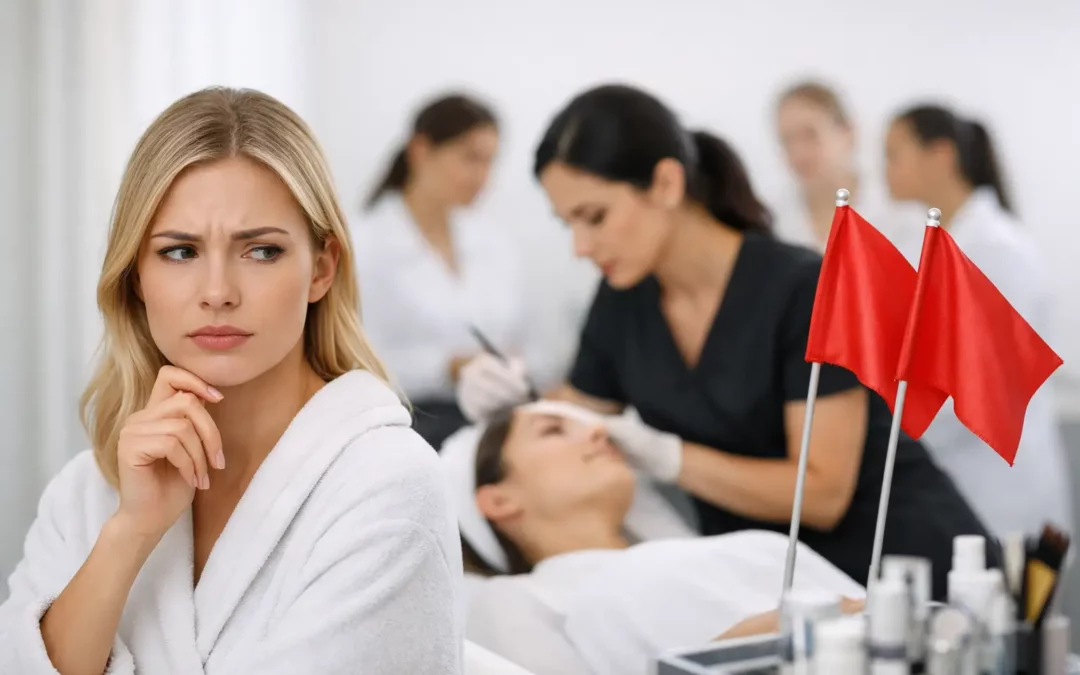
A cheap course can cost you far more than tuition. In beauty, bad education shows up later – in poor retention, unsafe habits, failed client trust, and the awful moment you realize your certificate did not actually prepare you to work. If you are comparing programs, these top beauty training red flags are the ones to take seriously before you hand over your money.
The beauty industry is full of opportunity, but it is also crowded with rushed courses, recycled manuals, and trainers who sell confidence before competence. That matters whether you want to offer lash extensions, brow services, facial waxing, or permanent makeup. A course is not just a purchase. It is the foundation of your reputation, your client safety, and your earning potential.
Why top beauty training red flags matter so much
A weak training program does not only leave gaps in technique. It can leave gaps in sanitation, contraindications, client consultation, legal compliance, and correction work. Those are not small issues. They affect whether you can perform services safely, whether clients come back, and whether your business grows or stalls.
This is especially important because beauty rules are not identical everywhere. Requirements can vary across provinces and states, and a serious educator should be able to speak clearly about what training can and cannot qualify you to do in your area. Anyone promising a one-size-fits-all answer is already giving you a reason to pause.
1. The trainer is vague about credentials and real experience
If a training page says an educator is an expert but does not explain why, that is a problem. You should be able to find clear information about who is teaching, what services they actually perform, how long they have worked in the field, and whether they operate in a properly licensed and insured setting where required.
Experience matters, but relevant experience matters more. Someone who took a course last month and immediately started teaching may be great at marketing and weak at mentoring. You are not looking for a personality. You are looking for someone who can teach technique, troubleshoot mistakes, and explain why standards exist.
2. The course promises fast certification with almost no practice
Speed sells. That is exactly why it can be dangerous. A same-day or ultra-short beauty course is not automatically bad, but when a provider acts like complex services can be mastered in a few hours, that is one of the clearest top beauty training red flags.
Hands-on services require muscle memory, judgment, and repetition. Lash mapping, isolation, adhesive control, skin assessment, brow symmetry, needle depth, color theory, and healing support are not things most students truly absorb through a slideshow alone. A serious course is honest about the learning curve and does not pretend that watching a demo is the same as being job-ready.
3. Infection control and safety are treated like side topics
This is where low-standard training exposes itself quickly. If sanitation, disinfection, setup, cross-contamination prevention, patch testing, contraindications, aftercare, and emergency response are skimmed over, walk away.
Clients trust you with their eyes, skin, and health. That means safety training is not extra content. It is core content. A provider that focuses only on pretty results for social media while glossing over infection control is training you to create risk, not a career.
4. There is no clear hands-on component or live model work
For practical beauty services, theory alone is not enough. You need to see the service performed correctly, then practice with supervision, feedback, and correction. If a course avoids discussing class size, model requirements, or how students are assessed during live work, be careful.
Small class sizes usually support better learning because the trainer can actually watch your setup, your body positioning, your pressure, your timing, and your sanitation habits. In a crowded room, students often leave with a certificate and the same mistakes they walked in with.
5. The curriculum is thin, generic, or suspiciously broad
If one course claims to teach multiple advanced services in a very short time, it is worth questioning how much depth you are really getting. Beauty education should be structured. There should be a clear curriculum covering consultation, contraindications, product knowledge, mapping or design, application or execution, maintenance, removals or corrections where relevant, troubleshooting, and client communication.
Generic manuals are another warning sign. If the material looks copied, overly basic, or disconnected from the actual service, it often means the provider is selling a package, not an education. Good training has a system behind it.
6. The provider cannot answer questions about compliance
This one matters more than many new students realize. Depending on the service, your region may have specific health authority expectations, licensing pathways, insurance considerations, age restrictions, or workplace rules. An ethical trainer will never make reckless promises about what a certificate automatically allows.
Instead, they will explain the scope of the training, what standards are taught, and what you need to confirm in your own area. That is especially relevant for students comparing options across provinces and states. Compliance is not glamorous, but it protects your business from expensive mistakes.
7. Support ends the minute you pay or graduate
A beauty course should not feel like a disappearing act. If a provider is responsive before payment and hard to reach afterward, that tells you a lot about how they view students.
Most people need guidance after class. Questions come up when you start working on real clients. Maybe retention is off. Maybe your brow stain is processing unevenly. Maybe a healed lip blush result needs evaluation. Ongoing mentorship is often the difference between a student who stays stuck and one who builds confidence fast.
That does not mean every academy needs unlimited access forever. It does mean post-training support should be clearly defined and real.
8. Marketing is polished, but student outcomes are unclear
Good branding is not a red flag. Empty branding is. If a course sells heavily through luxury visuals, countdown timers, and emotional promises but shows little evidence of student development, ask harder questions.
Look for proof of teaching, not just proof of selling. Can the educator explain their process? Do they show standards, setup, and technique correction? Do they talk about who the course is for and who may need more foundational support first? Strong educators care whether you are actually ready, not just whether you convert.
9. The program skips business education entirely
Technical skills matter, but most students are not training for a hobby. They are training to earn. If a program never addresses pricing, consultations, client retention, retail, photography standards, consent forms, boundaries, scheduling, or service positioning, it may leave you technically trained and commercially unprepared.
That does not mean every class needs an MBA-level business module. It does mean career-focused training should acknowledge the realities of building a beauty income. The best educators do not just teach you how to perform a service. They teach you how to deliver it professionally.
How to assess top beauty training red flags before enrolling
You do not need to become cynical. You do need to ask direct questions. Ask who teaches the course, how many students are accepted, what the hands-on portion looks like, what safety topics are covered, and what support exists after graduation. Ask what the certificate represents and what it does not represent. Ask what a beginner usually struggles with and how the trainer handles that.
Pay attention to how the provider answers. Clear, confident, grounded answers usually signal real experience. Defensive, evasive, or overly sales-driven answers usually signal the opposite.
It also helps to be honest about your own goals. A working beauty professional adding one service may need something different than a beginner starting from scratch. A course can be excellent for one student and a poor fit for another. That is not a flaw. What matters is whether the educator helps you make the right decision instead of forcing a fast yes.
At Voila Academy, we believe beauty training should be standards-driven, hands-on, and built for real careers, not quick certificates that leave students guessing once class is over. The right education should make you safer, sharper, and more confident in front of clients.
If a course feels rushed, vague, or more focused on the sale than the student, trust that instinct. The beauty industry rewards strong foundations. Choose training that respects your future enough to teach it properly.