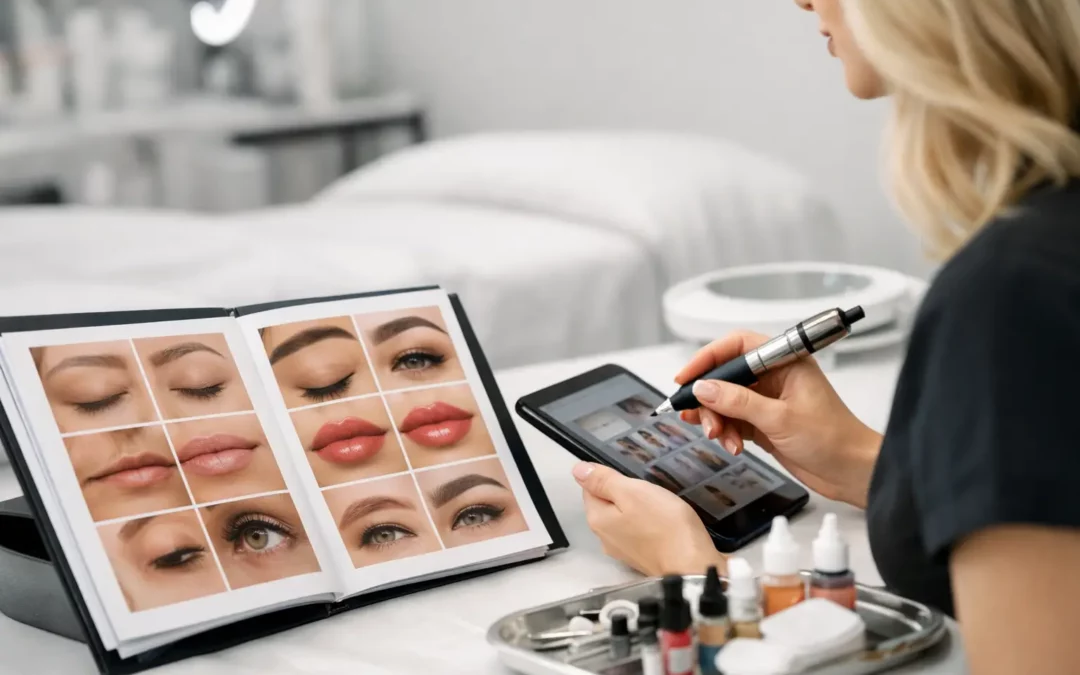
A permanent makeup portfolio can make a talented artist look unprepared – or make a newer artist appear more experienced than their work can support. This PMU portfolio transformation case study shows what changes when an artist stops posting random before-and-after photos and starts presenting work with clinical care, technical honesty, and a clear point of view.

The goal is not to create a feed full of filters, borrowed photos, or identical brows on every face. It is to build a portfolio that gives potential clients enough evidence to trust your eye, your technique, your sanitation standards, and your ability to make responsible decisions. In permanent makeup, that trust is part of the service.

The Starting Point: Good Work, Weak Proof

Consider a representative early-career PMU artist who had completed foundational training and had started taking models. She could create clean shapes and was developing solid machine control. Yet her portfolio was not helping her book the right clients.

Her gallery included inconsistent lighting, tightly cropped healed results, and several photos with beauty filters. Most posts showed only the finished result. There was little context about the client’s natural brow pattern, skin type, previous work, contraindications, or healing process. A prospective client could see pigment on skin, but could not see the artist’s judgment.

That is a common problem. New artists are often told to post constantly, so they post everything. More photos do not automatically create more confidence. If a portfolio is disorganized, heavily edited, or missing healed work, it can raise questions that a serious client may never ask out loud. They simply keep scrolling and book elsewhere.

For an artist building a career, the real issue is not whether the portfolio looks pretty. The issue is whether it proves that the work is safe, appropriate, and repeatable.

PMU Portfolio Transformation Case Study: The Audit

The first step in this PMU portfolio transformation case study was not taking new photos. It was removing work that did not represent the standard the artist wanted to uphold.

The artist reviewed every image using a simple professional test: Would this photo help a cautious client understand what was done, why it was done, and what they can realistically expect? If the answer was no, it did not belong in the featured portfolio.

Photos were set aside when the lighting changed the pigment color, the skin was too red to judge the result, or the image was so close that it hid the overall facial balance. Images with filters were removed entirely. Filters can make a feed feel polished, but they are a poor choice for a procedure where clients need to see texture, stroke placement, saturation, and realistic skin response.

The artist also noticed an uncomfortable pattern: most of the work featured similar brow styles on similar skin types. This was not proof of versatility. It was proof that her portfolio had not yet documented a broad enough range of client decisions.

That did not mean she should accept every client or perform every technique immediately. It meant she needed to build the portfolio deliberately, with appropriate models and supervised growth rather than pressure to look advanced before she was ready.

Building a Gallery That Earns Trust

The transformation centered on documenting work as a full client journey. Each selected case included a clear before photo, an immediate after photo, and, when available, a healed result before the touch-up. The artist used consistent lighting, a neutral background, and the same angles for every client.

This approach made the artist’s progress visible without exaggeration. It also gave clients a more useful picture of what permanent makeup actually involves. Fresh pigment is not healed pigment. Swelling, redness, skin type, aftercare, and individual retention all affect the final outcome. A portfolio that only shows fresh work may be visually impressive, but it does not answer the questions clients should be asking.

Before Photos Became Consultation Proof

The strongest before photos were not glamorous. They were clear.

A full-face image showed how the proposed brow shape or lip color worked with the client’s features. A closer image showed natural hair growth, asymmetry, sparse areas, prior tattooing, and skin condition. These details helped demonstrate that the artist was not applying a one-size-fits-all template.

For example, a client with oily skin and sparse brow hair may not be the ideal candidate for crisp, hair-stroke-focused work. A soft powder brow may offer better long-term visual stability. Showing the natural starting point, then explaining the chosen approach, positioned the artist as a professional making a recommendation – not simply selling the trend a client saw online.

Healed Results Did the Heavy Lifting

The artist made healed work a priority. She created a follow-up system, asked clients for consent to photograph results, and scheduled portfolio photos around the proper healing timeline. Not every client returned, and not every healed result was suitable for publication. That is normal.

What mattered was consistency. Over time, the portfolio began to show healed powder brows on different skin types, soft lip blush results with realistic color retention, and corrective work only where the artist’s training and scope supported it.

A healed result can be humbling because it exposes technique honestly. It may also be the most persuasive image in a PMU gallery. It tells clients that you understand the process beyond appointment day.

Captions Shifted From Sales Language to Professional Guidance

Instead of captions such as “Obsessed with these brows,” the artist began writing concise case notes. Each note identified the service, the client’s starting point, the design intention, and any relevant expectations about healing or touch-ups.

The tone remained client-friendly, but it became more educational. A caption might explain that a soft ombré effect was chosen to avoid overloading mature skin, or that a lip blush shade was selected to enhance natural tone rather than create lipstick-level coverage. That language attracts clients who value informed choices and helps discourage unrealistic requests.

The Safety Standard Was Visible, Not Assumed

A portfolio is not a substitute for a consultation, consent process, or proper training. It can, however, show clients that the artist takes professional practice seriously.

The transformed gallery included occasional behind-the-scenes content that showed a clean, organized treatment setup without compromising client privacy. It reinforced the habits clients should expect: single-use items where required, proper barrier protection, informed consent, aftercare education, and a clean environment.

Artists must also understand that PMU rules are not identical everywhere. Licensing, bloodborne pathogen requirements, local health authority expectations, and insurance requirements can vary across provinces and states. Before offering a procedure, verify the rules where you work and where your clients will be served. A certificate alone does not automatically grant permission to practice.

This is where shortcut training becomes expensive. A low-cost course may give you a certificate and a few social media photos, but it cannot replace supervised practice, infection control knowledge, model management, or an honest understanding of your current skill level. Your portfolio will eventually reveal the difference.

What Changed After the Transformation

The artist did not suddenly become a different technician. She became easier to evaluate.

Potential clients could now see a coherent body of work rather than a collection of isolated posts. They could identify which services the artist was actively building, see the difference between fresh and healed results, and understand that recommendations were based on skin, facial structure, and realistic outcomes.

That clarity also improved inquiries. Instead of receiving only price-shopping messages or requests for unsuitable styles, the artist began hearing from clients who had read the case notes and understood the service process. Those are often better consultation conversations because expectations begin in a more realistic place.

There is a trade-off. A more honest portfolio may look less dramatic than a heavily filtered gallery full of fresh, saturated results. It may also grow more slowly because healed work takes time. But the right clients are not looking for the loudest feed. They are looking for proof that their face is in careful hands.

How to Start Your Own Portfolio Reset

Start with a hard review of what is currently public. Keep only images that are accurately lit, unfiltered, consented to, and representative of work you are prepared to repeat. Then create a consistent photo process before your next model appointment, not after.

Focus on documenting fewer cases well. Capture the natural starting point, full-face balance, immediate result, and healed outcome whenever possible. Keep notes on skin type, pigment choice, technique, and touch-up decisions. Those records will make your consultations stronger and help you see patterns in your own work.

At Voila Academy, training is built around the reality that PMU careers are earned through standards, practice, and accountability. A beautiful result matters. So does knowing when to recommend a different technique, postpone a procedure, or refer a client when the case is outside your scope.

Your portfolio does not need to pretend you have ten years of experience. It needs to show that you respect the work enough to build your experience the right way. Start with one well-documented case, tell the truth about the process, and let your standards become visible.

A permanent makeup portfolio can make a talented artist look unprepared – or make a newer artist appear more experienced than their work can support. This PMU portfolio transformation case study shows what changes when an artist stops posting random before-and-after photos and starts presenting work with clinical care, technical honesty, and a clear point of view.

The goal is not to create a feed full of filters, borrowed photos, or identical brows on every face. It is to build a portfolio that gives potential clients enough evidence to trust your eye, your technique, your sanitation standards, and your ability to make responsible decisions. In permanent makeup, that trust is part of the service.

The Starting Point: Good Work, Weak Proof

Consider a representative early-career PMU artist who had completed foundational training and had started taking models. She could create clean shapes and was developing solid machine control. Yet her portfolio was not helping her book the right clients.

Her gallery included inconsistent lighting, tightly cropped healed results, and several photos with beauty filters. Most posts showed only the finished result. There was little context about the client’s natural brow pattern, skin type, previous work, contraindications, or healing process. A prospective client could see pigment on skin, but could not see the artist’s judgment.

That is a common problem. New artists are often told to post constantly, so they post everything. More photos do not automatically create more confidence. If a portfolio is disorganized, heavily edited, or missing healed work, it can raise questions that a serious client may never ask out loud. They simply keep scrolling and book elsewhere.

For an artist building a career, the real issue is not whether the portfolio looks pretty. The issue is whether it proves that the work is safe, appropriate, and repeatable.

PMU Portfolio Transformation Case Study: The Audit

The first step in this PMU portfolio transformation case study was not taking new photos. It was removing work that did not represent the standard the artist wanted to uphold.

The artist reviewed every image using a simple professional test: Would this photo help a cautious client understand what was done, why it was done, and what they can realistically expect? If the answer was no, it did not belong in the featured portfolio.

Photos were set aside when the lighting changed the pigment color, the skin was too red to judge the result, or the image was so close that it hid the overall facial balance. Images with filters were removed entirely. Filters can make a feed feel polished, but they are a poor choice for a procedure where clients need to see texture, stroke placement, saturation, and realistic skin response.

The artist also noticed an uncomfortable pattern: most of the work featured similar brow styles on similar skin types. This was not proof of versatility. It was proof that her portfolio had not yet documented a broad enough range of client decisions.

That did not mean she should accept every client or perform every technique immediately. It meant she needed to build the portfolio deliberately, with appropriate models and supervised growth rather than pressure to look advanced before she was ready.

Building a Gallery That Earns Trust

The transformation centered on documenting work as a full client journey. Each selected case included a clear before photo, an immediate after photo, and, when available, a healed result before the touch-up. The artist used consistent lighting, a neutral background, and the same angles for every client.

This approach made the artist’s progress visible without exaggeration. It also gave clients a more useful picture of what permanent makeup actually involves. Fresh pigment is not healed pigment. Swelling, redness, skin type, aftercare, and individual retention all affect the final outcome. A portfolio that only shows fresh work may be visually impressive, but it does not answer the questions clients should be asking.

Before Photos Became Consultation Proof

The strongest before photos were not glamorous. They were clear.

A full-face image showed how the proposed brow shape or lip color worked with the client’s features. A closer image showed natural hair growth, asymmetry, sparse areas, prior tattooing, and skin condition. These details helped demonstrate that the artist was not applying a one-size-fits-all template.

For example, a client with oily skin and sparse brow hair may not be the ideal candidate for crisp, hair-stroke-focused work. A soft powder brow may offer better long-term visual stability. Showing the natural starting point, then explaining the chosen approach, positioned the artist as a professional making a recommendation – not simply selling the trend a client saw online.

Healed Results Did the Heavy Lifting

The artist made healed work a priority. She created a follow-up system, asked clients for consent to photograph results, and scheduled portfolio photos around the proper healing timeline. Not every client returned, and not every healed result was suitable for publication. That is normal.

What mattered was consistency. Over time, the portfolio began to show healed powder brows on different skin types, soft lip blush results with realistic color retention, and corrective work only where the artist’s training and scope supported it.

A healed result can be humbling because it exposes technique honestly. It may also be the most persuasive image in a PMU gallery. It tells clients that you understand the process beyond appointment day.

Captions Shifted From Sales Language to Professional Guidance

Instead of captions such as “Obsessed with these brows,” the artist began writing concise case notes. Each note identified the service, the client’s starting point, the design intention, and any relevant expectations about healing or touch-ups.

The tone remained client-friendly, but it became more educational. A caption might explain that a soft ombré effect was chosen to avoid overloading mature skin, or that a lip blush shade was selected to enhance natural tone rather than create lipstick-level coverage. That language attracts clients who value informed choices and helps discourage unrealistic requests.

The Safety Standard Was Visible, Not Assumed

A portfolio is not a substitute for a consultation, consent process, or proper training. It can, however, show clients that the artist takes professional practice seriously.

The transformed gallery included occasional behind-the-scenes content that showed a clean, organized treatment setup without compromising client privacy. It reinforced the habits clients should expect: single-use items where required, proper barrier protection, informed consent, aftercare education, and a clean environment.

Artists must also understand that PMU rules are not identical everywhere. Licensing, bloodborne pathogen requirements, local health authority expectations, and insurance requirements can vary across provinces and states. Before offering a procedure, verify the rules where you work and where your clients will be served. A certificate alone does not automatically grant permission to practice.

This is where shortcut training becomes expensive. A low-cost course may give you a certificate and a few social media photos, but it cannot replace supervised practice, infection control knowledge, model management, or an honest understanding of your current skill level. Your portfolio will eventually reveal the difference.

What Changed After the Transformation

The artist did not suddenly become a different technician. She became easier to evaluate.

Potential clients could now see a coherent body of work rather than a collection of isolated posts. They could identify which services the artist was actively building, see the difference between fresh and healed results, and understand that recommendations were based on skin, facial structure, and realistic outcomes.

That clarity also improved inquiries. Instead of receiving only price-shopping messages or requests for unsuitable styles, the artist began hearing from clients who had read the case notes and understood the service process. Those are often better consultation conversations because expectations begin in a more realistic place.

There is a trade-off. A more honest portfolio may look less dramatic than a heavily filtered gallery full of fresh, saturated results. It may also grow more slowly because healed work takes time. But the right clients are not looking for the loudest feed. They are looking for proof that their face is in careful hands.

How to Start Your Own Portfolio Reset

Start with a hard review of what is currently public. Keep only images that are accurately lit, unfiltered, consented to, and representative of work you are prepared to repeat. Then create a consistent photo process before your next model appointment, not after.

Focus on documenting fewer cases well. Capture the natural starting point, full-face balance, immediate result, and healed outcome whenever possible. Keep notes on skin type, pigment choice, technique, and touch-up decisions. Those records will make your consultations stronger and help you see patterns in your own work.

At Voila Academy, training is built around the reality that PMU careers are earned through standards, practice, and accountability. A beautiful result matters. So does knowing when to recommend a different technique, postpone a procedure, or refer a client when the case is outside your scope.

Your portfolio does not need to pretend you have ten years of experience. It needs to show that you respect the work enough to build your experience the right way. Start with one well-documented case, tell the truth about the process, and let your standards become visible.