
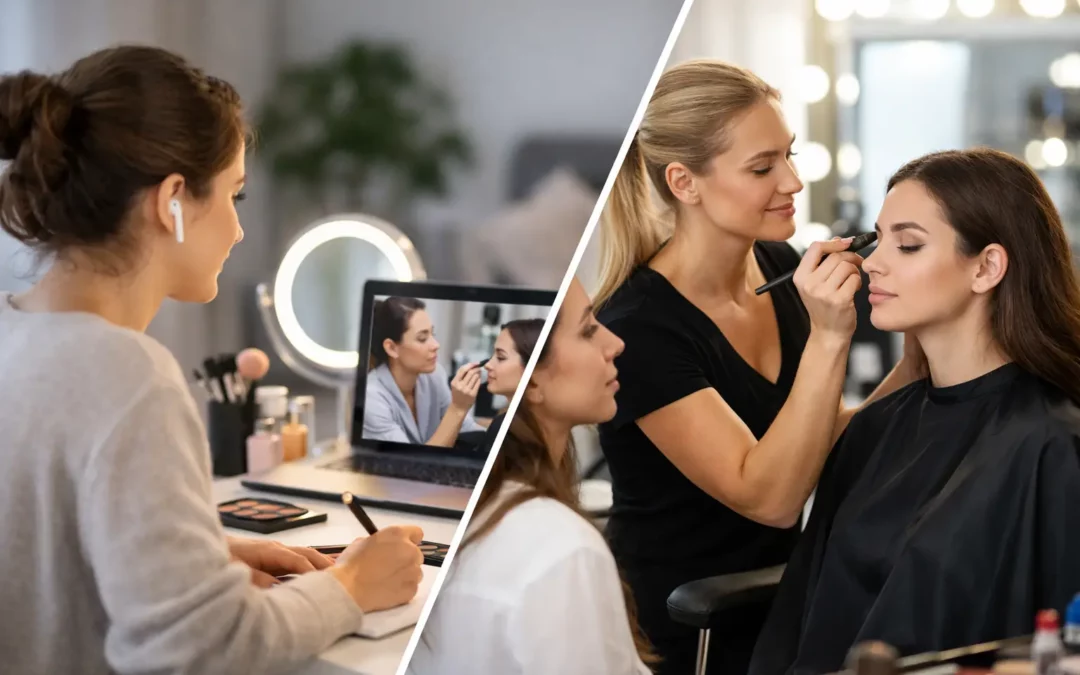
A certificate can look impressive on paper and still leave you unprepared to work on a real client. That is the real issue in the online vs in person beauty training debate. In beauty, the wrong training choice does not just slow your progress. It can affect client safety, service quality, retention, and your reputation before your business even gets off the ground.
If you want to build a serious career in lashes, brows, waxing, or permanent makeup, the question is not which format is cheaper or faster. The better question is what kind of skill you are trying to learn, how much support you need, and whether your training will actually hold up once you start taking paying clients.
Online vs in person beauty training: what really changes?
The biggest difference is feedback. Online education can deliver theory, demonstrations, business basics, and product knowledge very well. In-person education gives you live correction, hands-on practice, posture and pressure guidance, sanitation oversight, and the kind of immediate coaching that prevents bad habits from becoming permanent.
That distinction matters more in beauty than in many other industries. Most services are detail-driven and tactile. You are not just memorizing steps. You are learning how skin responds, how adhesive behaves, how to map a face, how to maintain symmetry, how to work cleanly, and how to adjust in real time when something does not go as planned.
A video can show technique. It cannot always tell you that your hand pressure is too heavy, your isolation is weak, your wax temperature is unsafe, or your brow mapping is drifting off balance on one side.
When online beauty training works well
Online training can be a smart option when it is built by a qualified educator and used for the right purpose. It works especially well for theory-heavy learning, foundational concepts, product chemistry, contraindications, client consultation flow, and business development. It can also be valuable for beauty professionals who already have a strong baseline and want to add a new service with disciplined self-study.
For example, an experienced esthetician adding lash lift and tint may benefit from online modules if the course is structured well and includes detailed demonstrations, safety instruction, and post-course support. A brow artist refining consultation language, pricing, or marketing systems may also get strong value from an online format.
Online learning is also flexible. That matters if you are working another job, raising kids, or trying to train without shutting down your income. You can review lessons more than once, pause demonstrations, and study at your own pace. For motivated learners, that convenience can be a real advantage.
But flexibility is not the same as mastery. A course being easy to access does not mean it is enough on its own.
Where online training falls short
The beauty industry has a quality problem. Too many online programs sell speed, low prices, and instant certification while skipping the depth required to produce safe, competent artists. That is where students waste money. They finish a course, receive a certificate, and still do not feel confident enough to work on clients without fear.
This is especially risky in services that require precise hand control and strong health standards. Eyelash extensions, facial waxing, brow lamination, microblading, powder brows, lip blush, and eyeliner all involve technique that can be difficult to assess accurately through a screen alone. Infection control, setup discipline, skin response, symmetry, stretching, needle depth, adhesive amount, and client positioning are not minor details. They are the work.
Without live correction, beginners often practice mistakes repeatedly. Then they have to spend more time and money unlearning them later. That is one of the hidden costs of low-quality online education. It looks affordable upfront, but it can delay income, damage confidence, and create safety issues that should never have made it into your routine.
Why in-person training still matters
In-person training remains the strongest option for most beginners and for most advanced hands-on services. Not because online learning has no value, but because tactile skills develop faster and more safely when an experienced trainer can watch what you are doing as you do it.
That matters from the first setup. A strong educator is checking your station organization, sanitation habits, client draping, body mechanics, timing, product usage, and your ability to maintain control under pressure. They are not just telling you what the steps are. They are helping you understand why each step exists and what can go wrong if you ignore it.
Small class sizes are a major factor here. In crowded training rooms, students can still be overlooked. Real education requires attention. If your trainer is balancing too many students, there is less chance you will get the correction and mentorship needed to build confidence properly.
In-person learning also gives you something many students underestimate – emotional clarity. When you practice on a live model with a trainer nearby, you get honest feedback in the moment. That removes guesswork. You leave knowing what needs work, what is improving, and what standard you are expected to meet before offering the service professionally.
Online vs in person beauty training by service type
Not every beauty service should be judged the same way. Some are more forgiving. Others demand a much higher level of supervised practice.
Lash lift and tint, henna brows, or basic theory modules can adapt reasonably well to online education when paired with strong support and clear practice requirements. These services still require care, but they are generally more realistic for remote learning than highly technical procedures.
Eyelash extensions sit in the middle. You can learn theory, mapping concepts, product knowledge, and styling online, but isolation, placement, direction, adhesive control, and speed usually improve much faster with in-person correction.
Facial waxing, brow lamination, microblading, powder brows, lip blush, and eyeliner lean much more heavily toward supervised hands-on training. Once skin integrity, bloodborne pathogen awareness, healing outcomes, and precision pressure become part of the service, weak instruction is not just inconvenient. It is irresponsible.
How to choose the right format for you
If you are brand new to the industry, be honest about your starting point. Most beginners benefit from in-person training or a hybrid structure that includes meaningful hands-on support. You need more than information. You need accountability, correction, and a trainer who can spot problems before they become part of your method.
If you already have experience, online education may be a useful tool for expanding your menu, sharpening theory, or adding business knowledge. The key is not assuming experience in one service automatically transfers to another. A great lash artist is not automatically prepared for permanent makeup. A skilled waxer still needs proper brow lamination training.
Your learning style matters too, but not in the way people often think. Being independent and motivated is helpful. It does not replace qualified supervision. If you know you hesitate to ask questions, struggle with self-discipline, or need direct feedback to improve, that is not a weakness. It is a sign you should choose a training environment that supports your success.
What to look for before you enroll
Whether the course is online or in person, credibility comes first. Look closely at who is teaching, what licenses and insurance are in place, whether health and safety standards are covered seriously, and how much actual support is included after the course ends.
Ask how students are evaluated. Ask whether the trainer provides feedback on practice work. Ask what happens if you complete the course and still do not feel ready. Ask whether the class size allows for real attention. Ask whether the education includes business guidance, because technical skill alone does not build a stable beauty career.
Most importantly, be cautious of any training that sells a shortcut. Fast certification is easy to market. Competence takes more effort. A serious educator will not promise overnight mastery, because that would be dishonest.
At Voila Academy, that standards-first approach matters because students are not training for a hobby. They are training to work on real people, protect their reputation, and build income with skills that need to last.
The right training format is the one that prepares you to perform safely, confidently, and professionally when nobody is standing next to you. Choose the path that gives you real skill, not just proof that you signed up.