
A lash course can look polished on a sales page and still leave you unable to isolate safely, create a clean fan, or recognize a dangerous reaction. That is why an online lash training comparison should go far beyond price, course length, and a certificate image. Your training is the foundation of every appointment, every client result, and every referral you earn.
Online education can be an excellent route into lash artistry or a smart way to add a service to an existing beauty business. But not every program is built for the responsibility that comes with working around a client’s eyes. The right course teaches technique, judgment, sanitation, consultation, and correction. The wrong one sells speed and calls it education.
Online lash training comparison: look past the certificate
A certificate shows that you completed a course. It does not automatically prove that the course prepared you to perform a service safely or professionally. When comparing programs, start by asking what you will actually be expected to demonstrate before certification is issued.
A serious educator has standards for student work. They may require clear photos and videos of your setup, isolation, placement, styling, retention, and aftercare process. They should explain what happens if your work needs improvement: Do you receive specific feedback and a chance to resubmit, or does everyone receive the same certificate regardless of the result?
That distinction matters. Lashes are not a service where “good enough” protects the client. Poor isolation can lead to stickies and discomfort. Incorrect adhesive use can affect retention and increase exposure to fumes. Overloading a natural lash or choosing an unsuitable length can compromise lash health. A program that evaluates your work helps you build the habit of noticing these details before they become a client problem.
Start with safety, scope, and local requirements
Before comparing modules or kits, confirm what you are legally permitted to offer where you plan to work. Licensing, sanitation, and scope-of-practice requirements can differ across provinces and states, and they can also vary by city, county, board, or insurer. An online certificate is not a replacement for any license, registration, insurance, or practical requirement that applies in your area.
A credible course should not avoid this conversation. It should teach you to verify your own local rules and cover the professional basics that apply anywhere: hand hygiene, surface disinfection, single-use items, safe product storage, contraindications, informed consent, patch-testing guidance when appropriate, and proper aftercare.
Watch for vague safety language. If a course says it is “fully certified” but does not explain who recognizes the credential, what training it includes, or what regulations still apply, ask questions. Marketing claims should never be your compliance plan.
Compare the way the technique is taught
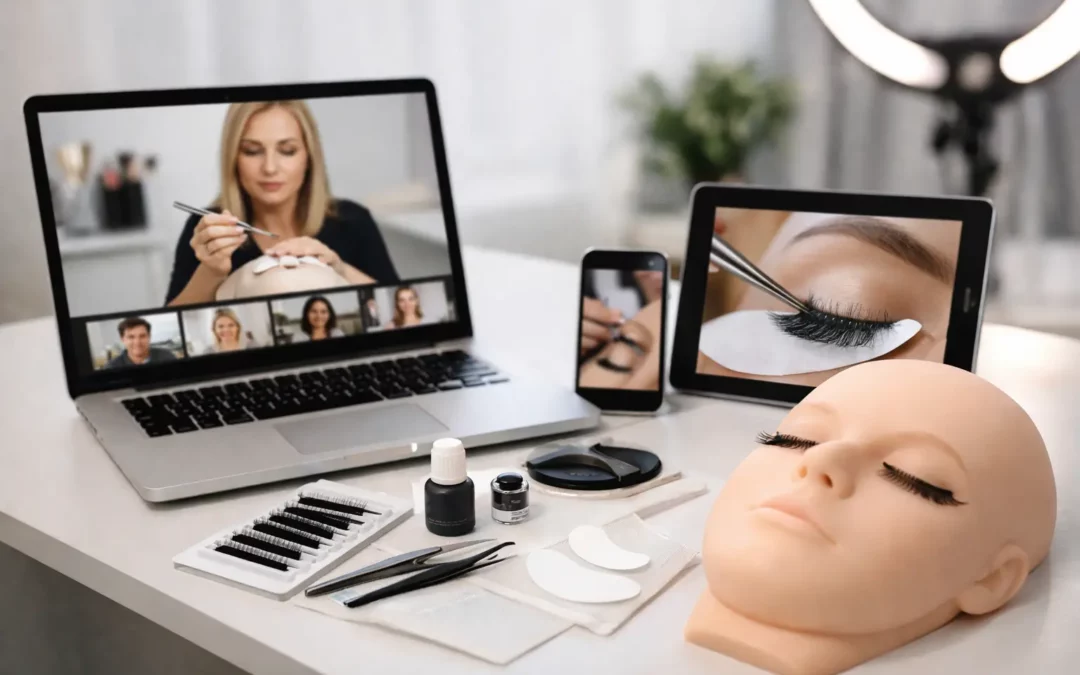
Pre-recorded lessons are not automatically a red flag. They can be useful because you can pause a close-up demonstration, repeat a theory module, and revisit styling information before a client appointment. The issue is whether the course relies on videos alone.
For a beginner, technique needs context. You need to understand why an artist chooses a certain curl, diameter, length, adhesive amount, or placement angle. You need to see what poor isolation looks like and how to correct it. You need instruction on mapping different eye shapes instead of copying one dramatic set onto every client.
Theory should support real decision-making
Compare course curricula line by line. A basic classic lash program should generally address natural lash growth cycles, eye anatomy awareness, styling and mapping, isolation, adhesive behavior, placement, direction, retention, fills, removals, client consultation, and aftercare. Volume training should go further into fan creation, weight selection, handmade versus premade fan standards, narrow versus wide fans, and avoiding overload.
Be cautious when a course promises to teach classic, hybrid, and volume techniques in a few short hours to complete beginners. It may introduce the concepts, but introduction is different from competence. If your goal is to build a lasting business, strong classic foundations are worth the time. Volume is not a shortcut around precise isolation and placement.
Live access changes the learning experience
The strongest online options include real access to an educator, whether through live coaching, scheduled feedback, virtual model assessments, or a defined support period. This is where you can ask why retention is failing, whether your lash direction is improving, or how to adjust a map for a hooded eye.
Ask how feedback is delivered and how long it takes. “Support included” can mean anything from an active instructor reviewing your work to a generic automated reply. Also ask whether the trainer is visible and identifiable. A legitimate educator should be transparent about their professional experience, teaching role, and training standards.
Practice requirements reveal the course standard
Lashing is a hands-on service. A mannequin can help you practice grip, adhesive control, and placement movement, but it cannot replace the variables of a live model: natural lashes growing in different directions, sensitive eyes, conversation, body positioning, and proper consultation.
Look for a course that has a structured practice path. You should know when to practice on a mannequin, when to work with models, how many supervised case studies are expected, and what photos or videos you must submit. A school that simply tells you to “practice until confident” gives you no benchmark. Confidence without correction can reinforce weak habits.
A course should also be honest about its limitations. Online training can provide valuable theory and mentorship, especially for students who do not live near an academy. Yet some learners need in-person help to correct hand position, isolation speed, or posture. The best program does not pretend that every student learns the same way. It gives you a path to get additional hands-on support when needed.
Compare the total investment, not the tuition alone
Low tuition can become expensive when essential tools, ongoing support, model requirements, and resubmission fees are added later. On the other hand, a large kit is not proof of quality if the products are poorly explained or the instruction is thin.
Review exactly what is included. Does the kit contain professional-use essentials, or are you expected to purchase basic sanitation supplies and application tools immediately? Are product instructions clear? Does the course teach you how to choose lashes and adhesive for your environment rather than treating one product as right for every artist?
Also consider the cost of poor training. Relearning technique, replacing unsafe products, losing clients because of retention issues, and paying for a second course can cost far more than choosing a standards-driven education from the start. Value comes from usable skill, informed feedback, and a credential you can stand behind.
Choose training that supports the business after certification
Lash education should prepare you for the appointment and the business behind it. That means consultation forms, pricing logic, policies, client communication, booking expectations, retail and aftercare recommendations, photography, and realistic timing goals. A technically beautiful set does not build a stable business if you cannot create consistent client experiences.
At Voila Academy, the focus is not on fast-food training that rushes students toward a certificate. It is on accountable education, safety-conscious practice, and the professional confidence to grow a service menu with intention. For an aspiring artist, that mentorship can be the difference between feeling stuck after graduation and knowing what to improve next.
Questions to ask before you enroll
Ask these questions directly. A quality school should be able to answer them without pressure or vague promises:
- Who provides feedback, and how are student submissions evaluated?
- What sanitation, contraindication, and infection-control topics are covered?
- Does the course require live-model practice and documented case studies?
- What support is available after completion, and for how long?
- What local licensing, insurance, and health requirements must I verify myself?
Pay attention to how the school responds. Clear answers, transparent policies, and realistic expectations are signs of an educator invested in your results. Pressure to buy immediately, promises of instant income, and dismissal of safety questions are signs to step back.
Your future clients will not care how quickly you received a certificate. They will care that their eyes feel comfortable, their lashes remain healthy, and their results last. Choose the training that makes you ready to earn that trust, one careful set at a time.