
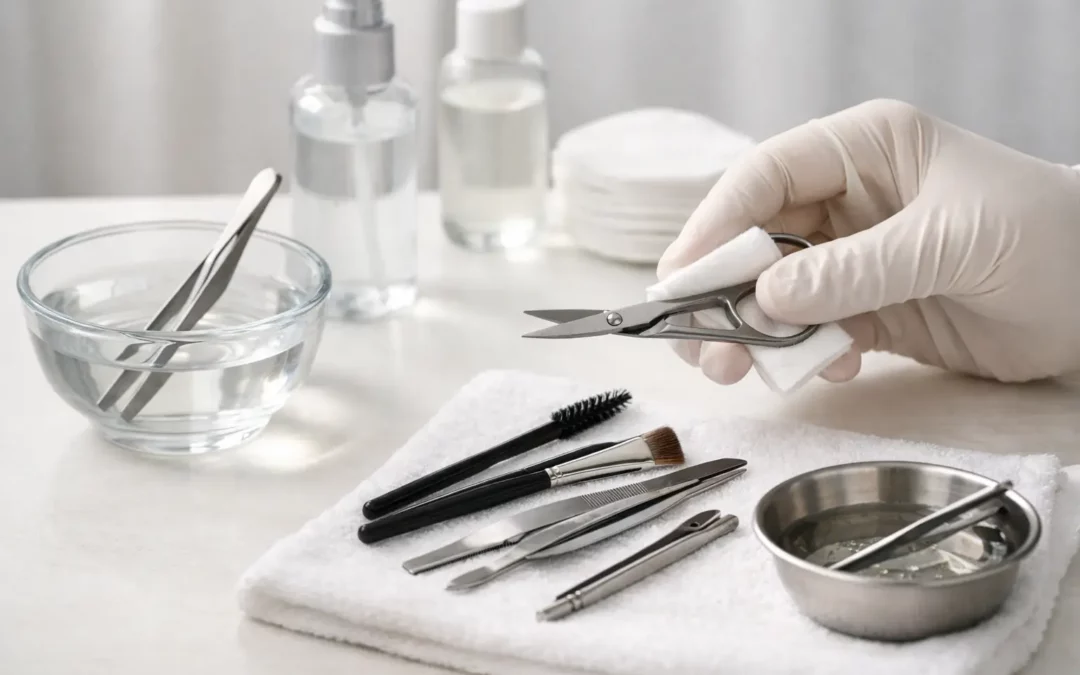
A spoolie tossed back into a drawer, tweezers wiped on a towel, scissors sprayed and used again – that is how contamination gets normalized in beauty spaces. If you are learning how to sanitize brow tools, start with this standard: if a tool touches skin, hair, product, or a workstation during a service, it needs a clear cleaning and disinfection process before it touches another client.
That might sound strict. It should. Brow services sit close to the eyes, often involve broken skin risk if handling is careless, and rely on small metal tools that can look clean long before they are actually safe. Good sanitation protects your client, protects your business, and protects your reputation. In this industry, nobody builds a lasting career on shortcuts.
Why sanitizing brow tools is non-negotiable
Brow artists work in an area where contamination can move fast. Oils, skin cells, makeup residue, blood spotting from tweezing, wax residue, and environmental debris all collect on tools and surfaces. A quick wipe removes what you can see. It does not reliably remove what can harm someone.
That distinction matters because cleaning and disinfecting are not the same step. Cleaning removes visible debris. Disinfecting uses the correct product, contact time, and process to reduce harmful microorganisms on nonporous tools and surfaces. If you skip cleaning and jump straight to disinfectant, residue can block the product from doing its job.
This is also where many new artists get tripped up by inconsistent advice online. Regulations and approved practices can vary by province and state, so your sanitation routine should always meet your local requirements first. If you are training seriously, that should be part of your education from day one, not an afterthought once you start taking paying clients.
How to sanitize brow tools step by step
If you want a professional standard, think in sequence, not in shortcuts. The order matters.
Step 1: Separate used tools immediately
Once a service ends, used tweezers, brow scissors, mapping calipers, and other reusable nonporous tools should go straight into a designated used-tools container. They should not sit loose on your station, go back into a clean drawer, or rest in your pocket while you turn over the room.
This simple habit prevents accidental cross-contamination and keeps your clean inventory genuinely clean.
Step 2: Clean off all visible residue
Before disinfection, wash the tool according to manufacturer guidance using soap or detergent and water as appropriate. Remove wax, henna, tint, skin debris, and product buildup completely. Pay attention to hinge areas, tips, and textured grips where residue likes to hide.
If the tool still looks cloudy, sticky, or coated, it is not ready for the next step. Disinfectant is not magic. It needs direct contact with the tool surface to work properly.
Step 3: Dry or prepare the tool as directed
Some disinfectant systems require tools to be rinsed and dried after cleaning. Others have specific instructions for going from cleaning straight into immersion. Read the label and follow it exactly. Professional sanitation is not about guessing what seems close enough.
Step 4: Disinfect using the correct product and contact time
Use a disinfectant intended for salon or professional use and approved for the tool type. Follow label directions for dilution, immersion, spray use, or wipe use, and pay close attention to contact time. If the label says the tool or surface must remain visibly wet for a certain number of minutes, that time is part of the process.
This is one of the biggest weak spots in beauty businesses. People spray and wipe instantly, then assume the tool is disinfected. It is not. If the product did not stay on long enough, you did not complete the step.
Step 5: Rinse if required, then dry fully
Some disinfectants require a post-soak rinse, especially for tools that will contact skin closely. Others do not. Again, follow manufacturer instructions. After that, dry the tool thoroughly with a clean disposable towel or allow it to air dry in a protected area.
Moisture left on tools can create its own problems, including corrosion and contamination from handling.
Step 6: Store sanitized tools correctly
Clean, disinfected tools should be stored in a covered, clean container or closed storage area that protects them from dust, splash, and workstation contamination. Tossing them onto an open tray beside used items defeats the point.
A professional setup makes it obvious what is clean, what is used, and what is single-use only. Clients notice that level of control.
Which brow tools can be sanitized and which should be disposable
Not every item in your brow setup belongs in the same category. Nonporous reusable tools such as stainless steel tweezers, brow scissors, and some measuring tools can usually be properly cleaned and disinfected if the manufacturer allows it. Porous, absorbent, or difficult-to-clean items should not be reused between clients.
That means spoolies, cotton rounds, lip applicators, mascara wands, wooden sticks, and many brow brushes should be treated as single-use unless they are specifically designed and approved for safe reprocessing. If you have to debate whether you can clean it well enough, it is probably not the item to reuse.
There is a business lesson here too. Trying to stretch disposable supplies to save a small amount of money can cost you client trust very quickly. Serious professionals build pricing around safe service delivery, not around cutting corners on sanitation.
Common mistakes when sanitizing brow tools
The most common mistake is confusing visibly clean with properly disinfected. The second is relying on alcohol for everything. Alcohol has a place in some settings, but it is not a catch-all substitute for a full cleaning and disinfection protocol on every tool and surface.
Another mistake is mixing products or making your own dilution without checking the label. More product does not always mean better performance, and improper mixing can make a disinfectant ineffective or unsafe.
Then there is timing. Rushing turnover between clients leads people to skip soaking times, miss residue in tool joints, or handle clean tools with contaminated gloves. Fast service is never more valuable than safe service.
Workstation hygiene matters too
If you know how to sanitize brow tools but ignore the rest of your setup, you still have a weak sanitation chain. Your tray, lamp handle, bed, chair arms, product containers, and mapping tools can all become contamination points during a brow service.
Gloves help in some services, but gloves are only clean until they touch something dirty. If you answer your phone, adjust your apron, open a drawer, or touch a used wax stick while gloved, those gloves may need to be changed. Hand hygiene still matters before and after every client and anytime contamination occurs mid-service.
This is why strong training focuses on systems, not random tips. Infection control is a workflow. Every step supports the next.
How often should brow tools be sanitized?
Reusable brow tools should be cleaned and disinfected after every client use. Not at the end of the day. Not when they start to look dirty. After every client.
At the start and end of the day, your broader station should also be cleaned and disinfected according to the products and surfaces involved. If a tool is dropped mid-service, treat it as contaminated. If a tool comes into contact with blood or compromised skin, your handling needs to follow stricter protocols and local regulations.
For students and new artists, this is worth hearing clearly: sanitation is part of the service itself. It is not extra work added on after the creative part.
Building a brow business on real standards
Clients may not know the technical name of every disinfectant on your shelf, but they can tell when an artist runs a clean, controlled service. They can see whether tools come from a protected container, whether disposable items are actually new, and whether your setup feels disciplined.
That discipline becomes part of your brand. It is also part of your legal and professional responsibility, especially if you plan to grow, hire, or operate across different compliance environments in provinces and states. Standards are not there to slow you down. They are there to keep your work credible.
At Voila Academy, this is the kind of foundation we care about because skill without safety is not professionalism. A beautiful brow result means very little if the process behind it is careless.
If you want to be taken seriously in beauty, let your sanitation habits say it before your marketing does.