
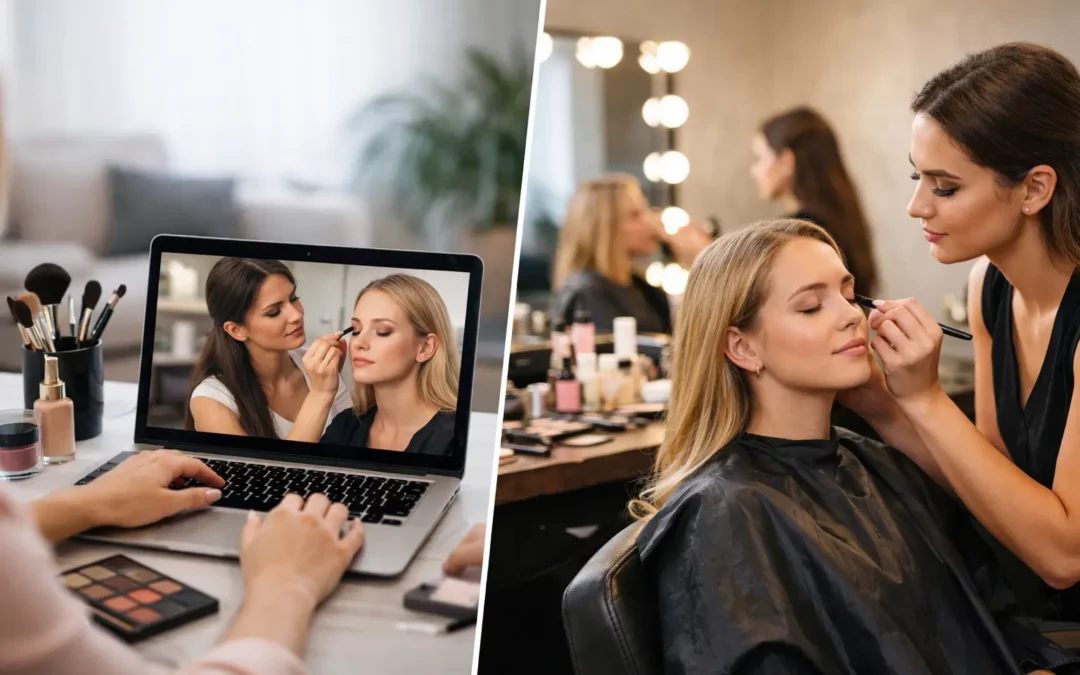
A polished certificate can look convincing on social media. It cannot tell a client whether you understand sanitation, can isolate a natural lash safely, recognize a contraindication, or create balanced brows on a real face. So, do online beauty courses work? They can, but only when the course is built around legitimate education, practical accountability, and the requirements of the service you plan to offer.
For aspiring artists, online education is not automatically a shortcut or a scam. It is a delivery format. The real question is whether the training gives you the technical foundation, feedback, and professional judgment required to work responsibly. In beauty, the difference matters because your work affects real clients, real skin, real eyes, and your reputation.
When Do Online Beauty Courses Work?
Online beauty courses work best when they teach concepts that can be learned clearly through demonstration, repetition, and guided study. Theory-heavy subjects such as infection control principles, product knowledge, consultation procedures, client aftercare, mapping concepts, business setup, pricing, and marketing can be taught very effectively online.
A strong course can also make demonstrations easier to revisit. In a live class, you may see a trainer perform a lash set or brow lamination once, take notes quickly, and hope you remember every detail. With well-produced online lessons, you can pause, replay, study hand placement, and return to a technique before practicing it yourself. That is valuable, especially for busy professionals adding a new service to an existing menu.
Online learning also works well when it includes a structured path rather than a folder of random videos. Beginners need lessons in the right order: sanitation before service setup, consultation before application, foundational technique before speed, and correction before advanced styling. If the course skips those steps to get you to a certificate faster, it is not serving your long-term career.
The strongest online programs create accountability. They ask for clear photos or videos of your practice work, provide detailed feedback, set standards for completion, and give students a way to ask questions when something does not look right. Without that feedback loop, a student can repeat the same mistake for weeks and become more confident in poor technique.
Where Online Training Has Limits
Beauty is hands-on. No screen can physically correct the pressure of your tweezers, the angle of a waxing application, the stretch of your client’s skin, or the depth of a permanent makeup procedure. Those skills require supervised practice, particularly for services that involve adhesives, chemical solutions, blades, needles, pigments, or close work around the eyes.
This does not mean every online course is ineffective. It means you need to be honest about what the course can and cannot provide. A beginner learning classic lash extensions may benefit from online theory and detailed demonstrations, but should still expect to practice extensively and receive qualified feedback before accepting paying clients. An advanced artist refining lash styling may get significant value from online education because they already understand the basics of isolation, safety, and client setup.
Permanent makeup deserves even more caution. Microblading, powder brows, lip blush, and eyeliner are not casual add-on services. They require a serious understanding of skin, color theory, contraindications, sanitation, healing, machine or manual technique, and client expectations. Depending on where you work, practical training, bloodborne pathogen education, permits, inspections, or licensing may be required before you can legally offer these services.
A course that tells you that one weekend of videos makes you ready for every client is selling confidence before competence. That is not education. It is fast-food training, and clients often pay the price when artists are underprepared.
A Certificate Is Not Always a License
This is one of the most expensive misunderstandings in beauty education. A certificate shows that you completed a course. It does not automatically give you legal authority to perform a service, rent a suite, obtain insurance, or operate in every location.
Requirements vary across provinces and states, and they can also differ by county, city, health authority, or board. A service that is lightly regulated in one area may require formal licensing, specific training hours, facility approval, or professional insurance somewhere else. This is especially true for permanent makeup, waxing, and services that may be classified under esthetics, cosmetology, tattooing, or body art rules.
Before enrolling, ask yourself where you intend to work. Then verify the rules with the appropriate local regulator, not just with a course provider or a social media comment section. Responsible educators can explain the scope of their training and encourage you to confirm local requirements. They should never promise that a certificate overrides the law.
What to Look for Before You Enroll
The quality of an online beauty course shows up in the details. Start with the educator. Can you identify who is teaching, what services they perform, their experience level, and whether they work within a legitimate professional setting? A transparent trainer is not hiding behind stock photos, vague claims, or a certificate template.
Look closely at the curriculum. It should cover more than the finished look. For lashes, that includes eye health considerations, allergies, adhesive safety, isolation, retention, removal, and styling. For brows and waxing, it should include skin assessment, contraindications, sanitation, product timing, and client aftercare. For permanent makeup, it should go far beyond a pigment color chart.
You should also know how feedback works before you pay. Ask whether assignments are reviewed, who reviews them, how many submissions are allowed, and whether support ends the moment the certificate is issued. Mentorship does not mean a generic reply sent to every student. It means someone can identify what is happening in your work and tell you how to improve it.
A worthwhile course should be clear about what is included, whether a kit is appropriate for safe practice, and what tools you will need after training. Very cheap tuition can become expensive when the course leaves out essential education, uses poor-quality supplies, or forces you to retrain later.
Make Online Learning Work in Your Hands
Your results depend on how you approach the course. Watching lessons between errands and rushing through modules will not create professional skill. Treat your online education like a real commitment: study the theory, set up a clean practice area, take clear notes, and schedule deliberate practice instead of hoping improvement will happen naturally.
Practice on approved mannequins, practice materials, or models only when you are ready and when the service allows it. Take photos in consistent lighting so you can see changes in symmetry, placement, direction, and overall finish. More importantly, learn to evaluate your work honestly. A set of lashes can look full in a filtered photo while still having poor isolation. A brow can appear bold while being uneven or poorly suited to the client’s features.
Do not rush to charge clients because you have a certificate in hand. Build a portfolio slowly, use clear consultation and consent practices, and stay within the limits of your training and local rules. The artists who last are not the ones who start fastest. They are the ones who protect their clients and keep improving.
The Better Question to Ask
Instead of asking whether online beauty education works in general, ask whether a specific program gives you a responsible route from learning to practice. Does it teach safety? Does it include real educator feedback? Does it explain legal and professional limits? Does it prepare you to solve problems, not simply copy a result?
Voila Academy believes beauty training should create capable professionals, not just quick certifications. Whether you learn online, in person, or through a blended approach, choose education that respects the skill, the client, and the career you are building.
The right course should leave you with more than a document to post. It should give you the judgment to pause when something is unsafe, the technique to deliver consistent work, and the confidence to build a business your clients can trust.