
If your lash sets keep looking uneven, heavy at the corners, or just not as flattering as you pictured, the problem is often not your placement speed. It is the plan. A solid beginner guide to lash mapping starts with one truth every new artist needs to hear early: beautiful sets are designed before they are applied.
Lash mapping is the blueprint for an eyelash extension set. It tells you where shorter, longer, tighter, or softer lengths belong across the lash line so the final look suits the client’s eye shape, natural lashes, and styling goal. Beginners sometimes treat mapping like a trend chart copied from social media. That is where sets start to look generic, uncomfortable, or poorly balanced.
At a professional level, lash mapping is not about memorizing one doll eye, cat eye, or wispy pattern and using it on everyone. It is about making style decisions with intention. That matters even more if you plan to build a real career, because clients come back for customized work, not random lash placement.
What lash mapping actually does
A lash map gives structure to your set. It helps you control symmetry, direct the eye visually, and avoid placing lengths where the natural lashes cannot safely support them. It also keeps your work consistent from one eye to the other, which is one of the first things clients notice even if they cannot explain why.
For beginners, mapping also slows you down in a good way. New artists often rush into application because they want practice with tweezers and adhesive. But if the design is weak, better isolation will not save the set. The map is where you solve shape problems before they happen.
This is also where training quality matters. A weak course may hand you a few trendy styles and call it enough. Serious education teaches why a map works, when it does not, and how to adjust it for different clients, regulations, and professional standards across both provinces and states.
Beginner guide to lash mapping basics
Start with the natural lash line, not the style name. Before you draw anything, look at the client with eyes open and relaxed. Are the eyes round, almond, hooded, downturned, upturned, close-set, or wide-set? Do the inner and outer corners grow strongly, or are they sparse and fragile? Does one eye sit slightly different from the other? Most clients are not perfectly symmetrical, so your map should not be copied mindlessly from left to right.
Then decide the result you want. Do you want to open the eye, elongate it, lift the outer corner, or create a soft balanced effect? The goal affects the placement of your longest lengths. That is the real job of mapping.
A typical lash map divides the eye into sections from inner corner to outer corner. Each section gets a planned length. Shorter lengths usually sit in the inner corner because natural lashes there are finer and shorter. Length builds gradually toward the focal point, then either softens or tapers depending on the chosen style.
Curl and diameter matter too. Beginners often focus only on length, but the same length can look completely different with a C curl versus a D curl. A thicker diameter can also make a set look denser and heavier, which changes the visual result and the stress on natural lashes.
The main lash styles and when they work
Cat eye maps place the longest lengths toward the outer third of the eye. When done well, this style elongates the eye and creates a sultry effect. When done badly, especially on downturned eyes, it can drag the face downward and make the outer corners look tired.
Doll eye maps place the longest lengths near the center. This opens the eye and works well for clients who want a bright, rounder look. On already very round eyes, though, it can exaggerate roundness more than the client wants.
Open eye styling is similar but usually softer and more balanced than a dramatic doll eye. It is often one of the safest places for a beginner to start because it flatters many eye shapes without pushing too hard in one direction.
Squirrel or kitten styles place the peak slightly past the center, then taper toward the outer edge. This can create lift and softness at the same time. For many clients, it is more wearable than a strong cat eye.
The trade-off is simple. The more dramatic the style, the more careful your assessment needs to be. Dramatic maps are not wrong, but they leave less room for guesswork.
How to build a lash map step by step
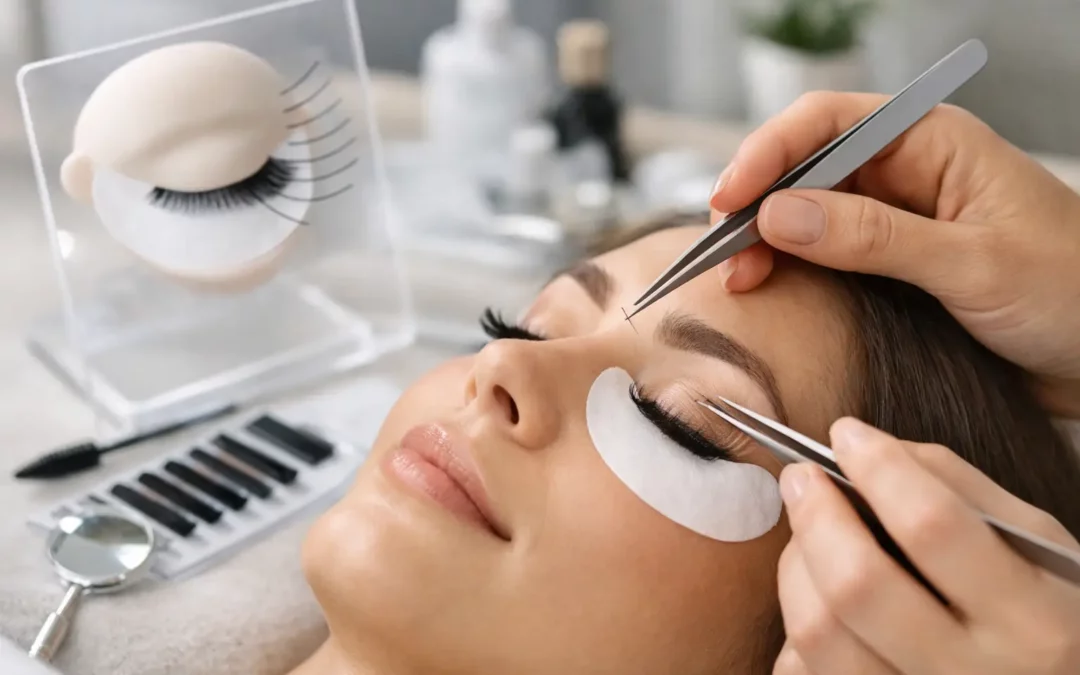
Begin with clean, prepped lashes and secured under-eye pads or tape. Ask the client to look straight ahead before closing their eyes so you can study the eye shape properly. Once the eyes are closed, use a fine pen to mark sections on the pad beneath each eye.
Most beginner maps use five to seven sections. That is enough detail to control the design without overwhelming you. Label each section with the intended length. For example, an open eye set might move from shorter inner corner lengths up to the longest in the center, then taper down toward the outer corner.
Keep your transitions smooth. Jumping from one length to another too abruptly can make the set look choppy unless you are intentionally creating texture. Beginners usually get cleaner results by increasing and decreasing lengths gradually.
Check both eyes before you start lashing. One of the easiest mistakes is drawing similar looking maps that are not actually balanced in position. The longest length should sit at the same visual point on both eyes unless you are correcting visible asymmetry.
As you work, the map is a guide, not a prison. If you notice the natural lashes in one section are weak, sparse, or shorter than expected, adjust. Good lash artists do not force a design onto lashes that cannot carry it safely.
Common beginner mistakes in lash mapping
The first is overlength. New artists often think bigger means prettier, but overlong extensions can twist, droop, and damage natural lashes. A flattering set has support behind it. If the natural lash cannot handle the extension, the map is wrong no matter how nice it looks on paper.
The second is ignoring eye shape. A copied map from a mannequin or tutorial may not suit the client in front of you. This is why trend-based training falls short. Real work is not paint-by-numbers.
The third is neglecting direction. Mapping is not just about where lengths go. Lash placement angle affects how the eye reads. Poor direction can make a set look crossed, messy, or asymmetrical even with a decent map.
The fourth is treating inner and outer corners like an afterthought. Those areas often need more restraint, not more drama. If corners are too long or too dense, the set loses polish fast.
Beginner guide to lash mapping for better retention and safety
A good map should protect lash health, not just create a style. That means choosing lengths, curls, and diameters based on natural lash integrity. Fine lashes need lighter choices. Mature clients may need a softer design. Clients with sparse outer corners may need a revised shape instead of a forced cat eye.
This is where professional standards matter. Infection control, patch placement, eye pad positioning, product quality, and proper styling all work together. Lash mapping is part artistry, but it is also part responsibility. If your education skips safety and anatomy, you are not getting the full picture.
Beginners should also remember that regulations and scope expectations can vary across provinces and states. If you plan to train, certify, and work professionally, choose education that prepares you for compliant, accountable practice rather than social media shortcuts.
How to practice lash mapping so it actually sticks
Practice on paper first. Draw different eye shapes and map styles over them until you understand where the focal point moves. Then practice on mannequin heads or styling strips before working on live models.
Take photos of your finished sets and compare them to your maps. Did the style land where you intended? Did one eye peak higher or longer than the other? Did the outer corners drop? This kind of review builds design judgment faster than simply doing more sets without reflection.
It also helps to keep your early styling simple. A clean, balanced set will build your reputation faster than a complicated wispy map you cannot execute consistently. There is nothing wrong with ambition, but strong fundamentals are what create lasting careers.
If you are serious about becoming a lash artist, learn mapping from an educator who teaches customization, sanitation, client assessment, and real-world application standards. At Voila Academy, that mentorship-first approach is the difference between getting a certificate and actually being ready to work.
Lash mapping gets easier when you stop chasing a perfect formula and start reading the face in front of you. That is when your sets begin to look less copied and more professional.