
A permanent eyeliner training class can either set up your career – or leave you with a certificate that means very little when a real client sits in your chair. That is the truth many students learn too late. Eyeliner tattooing is not a casual add-on service. It works close to the eye, demands precision under pressure, and leaves no room for weak fundamentals.
That is why this training choice deserves more scrutiny than a flashy social post or a discounted tuition price. If you are serious about adding permanent eyeliner to your service menu, you need more than a quick demo and a printed manual. You need education that treats safety, technique, judgment, and client care as non-negotiable.
What a permanent eyeliner training class should actually teach
A strong permanent eyeliner training class should do more than show you how to draw a pretty line. The real job is teaching you how to work safely and consistently on one of the most delicate areas of the face.
That starts with skin knowledge, contraindications, client consultation, mapping, pigment selection, machine control, needle depth, pressure, and stretch. It should also cover eye anatomy as it relates to the service, healing expectations, aftercare, touch-up planning, and when to decline a client. If any course skips over these topics or rushes through them, that is a warning sign.
Technique matters, but judgment matters just as much. A beginner needs to understand why one client is suitable for a lash enhancement while another may need a softer design, a different placement, or no service at all. Good training helps you make those calls with confidence instead of guessing.
Why shortcut training is risky in eyeliner tattooing
Permanent makeup has attracted plenty of low-standard education providers. Some sell fast certification with minimal hands-on practice because they know students are eager to start earning. The problem is that eyeliner is one of the worst services to learn through shortcuts.
The margin for error is small. Working too deep, choosing poor shape placement, overworking the skin, or misunderstanding swelling can create results that are difficult to correct. Even if the cosmetic result looks acceptable at first, poor technique often shows up during healing.
Cheap training can become expensive very quickly. Students often pay twice – first for the low-cost course, then again for real education after they realize they are not prepared to perform the service safely. Worse, some never recover their confidence because the foundation was weak from the start.
The difference between watching and learning
Many beginners assume a live demo equals hands-on education. It does not. Watching an instructor perform eyeliner is useful, but it is only one part of learning. You still need guided practice, correction, repetition, and honest feedback.
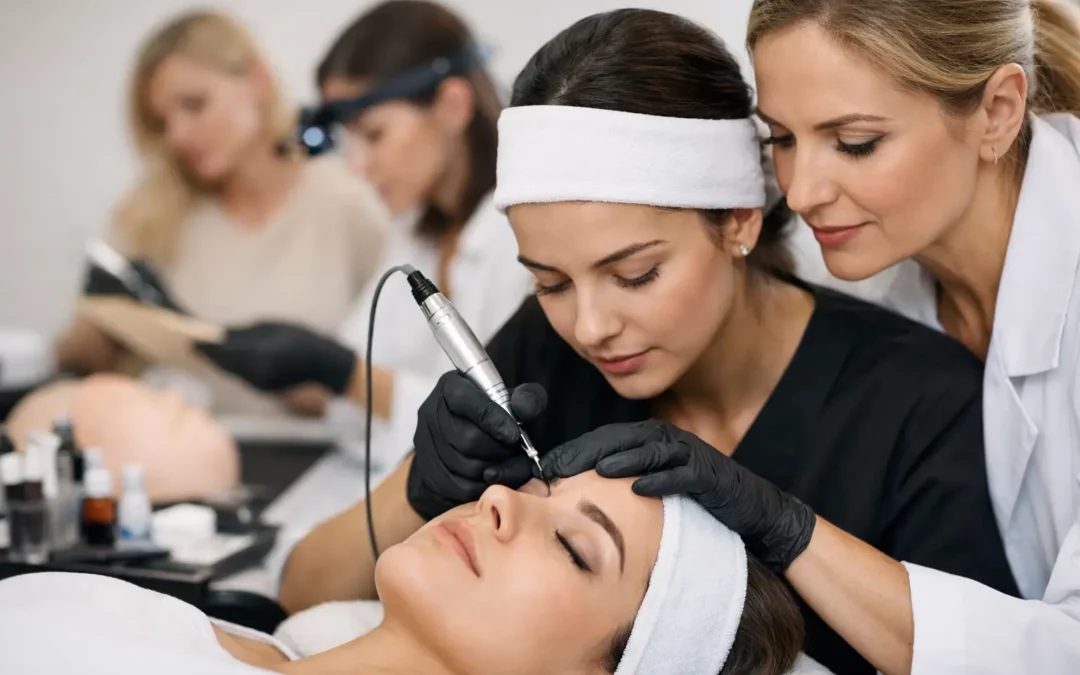
That is where class structure matters. Small class sizes usually allow better supervision, especially for a service that requires exact hand control and careful body positioning. If the instructor cannot clearly see what each student is doing, students can reinforce mistakes without realizing it.
A serious course should also include supervised work on practice media before moving into live model work. Rushing students onto models may look exciting in marketing photos, but excitement is not the same as readiness.
What to look for in hands-on eyeliner training
If you are comparing programs, ask direct questions. A credible academy should be comfortable answering them.
Find out how much of the course is theory versus practical application. Ask whether you will work on live models, how model practice is supervised, and what level of correction the instructor provides during the procedure. Ask what infection control training is included and whether the training business operates in a licensed, insured, standards-driven environment.
You should also ask about class size, student support after training, and whether the trainer is transparent about local regulations and scope-of-practice expectations. A good educator does not sell false confidence. They explain the responsibility that comes with the service.
Signs the course is built for real career growth
Not every student needs the same training path. Some are brand new to beauty. Others already offer brows, lashes, or esthetics services and want to expand. A quality program accounts for that, but it still protects the standard.
Look for training that includes business basics alongside technique. That might mean consultation forms, pricing guidance, client communication, healing follow-up, photography standards, and realistic advice about building demand. The goal is not just to help you pass a class. It is to help you perform professionally after class.
That mentor-driven approach is one reason many students seek out structured academies like Voila Academy rather than chasing the cheapest seat available. They want education that helps them build a service, not just collect a certificate.
A permanent eyeliner training class is also about safety culture
Eyeliner tattooing requires a different level of caution than many entry-level beauty services. You are working near the eye, managing client movement, and maintaining strict sanitation from setup to disposal. That means your training should reflect a real safety culture, not just a slide deck on hygiene.
Infection control should be taught as a daily operating standard. Students should understand barrier methods, cross-contamination prevention, workstation setup, PPE use, sharps handling, and proper cleanup. They should also know how to document services, screen clients responsibly, and recognize situations that require postponing treatment.
This part of training is often underappreciated by beginners because it does not feel glamorous. But professionals know better. Safety is part of your brand, your reputation, and your legal protection.
Who should take this kind of class
A permanent eyeliner training class can be a strong next step for several types of students. It makes sense for aspiring PMU artists who want to build a specialized service menu from the ground up. It also makes sense for licensed beauty professionals who already have an established client base and want to increase revenue with higher-ticket services.
That said, being eager is not the same as being ready. If a student struggles with sanitation discipline, basic consultation skills, or client management, those gaps need attention. The best educators will encourage growth without pretending every student should move at the same speed.
For some, eyeliner is the right first PMU service. For others, it may be better after developing hand control and confidence through related services. A trustworthy trainer will tell you the difference.
How to judge the instructor, not just the course ad
Course marketing can be polished. What matters is the educator behind it. Look beyond before-and-after photos and ask whether the instructor has a clear teaching system, not just artist talent.
A skilled artist is not automatically a strong trainer. Teaching requires the ability to break down technique, spot errors early, explain why corrections matter, and support students without sugarcoating problems. If an educator cannot clearly explain their process, students are left to copy instead of understand.
Transparency is another major factor. You should know who is teaching, what their experience includes, how the class is structured, and what support exists after completion. When providers are vague, students usually pay the price.
What happens after class matters just as much
One-day confidence often fades the moment a student gets home and realizes they still have questions. That is normal. Eyeliner tattooing involves repetition, reflection, and continued refinement.
This is why post-training support matters. Can you ask follow-up questions? Is there mentorship available when you review healed results or prepare for your first independent clients? Will someone help you troubleshoot retention, shape issues, or client eligibility concerns?
A real training program should not disappear once tuition clears. The most valuable education includes accountability after class, because that is when many technical and business questions finally become real.
Choose training that respects the service
Permanent eyeliner is a profitable service, but profit should never be the first lens. Precision, safety, and professional standards come first. When those are built correctly, income follows with much less chaos.
If you are investing in a permanent eyeliner training class, choose one that respects the level of responsibility involved. Look for serious hands-on education, clear safety standards, honest mentorship, and a trainer who wants you competent – not just certified.
The right class will not promise an easy shortcut. It will give you something far better: a foundation you can trust when it is your name attached to the work.