
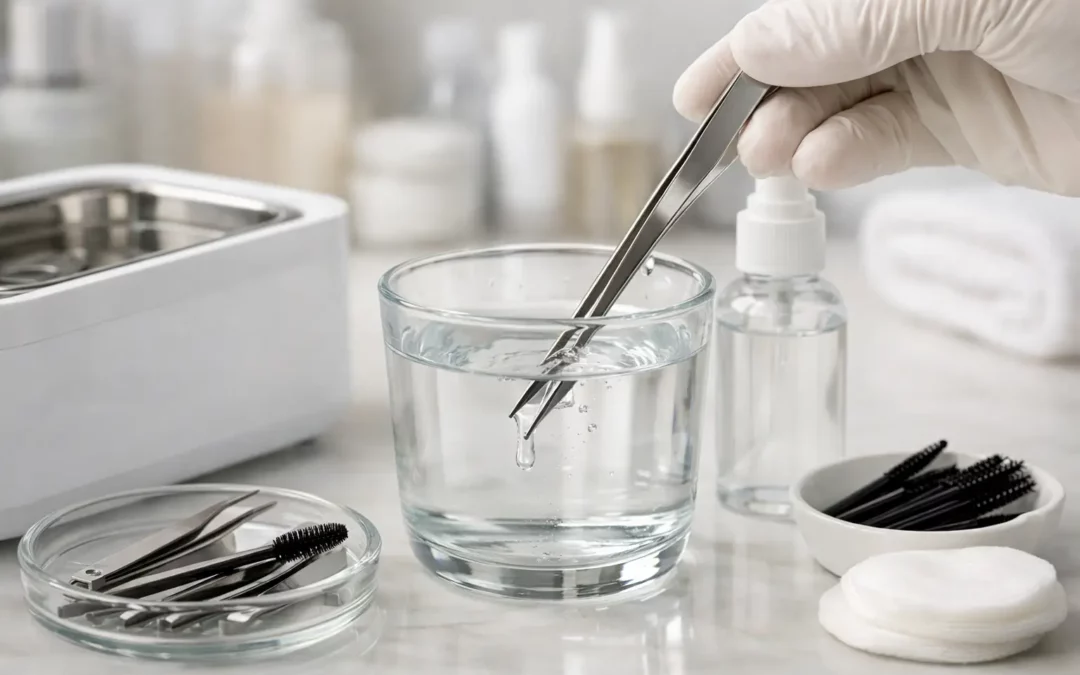
A client should never have to wonder whether your tweezers, scissors, or lash lift tools were truly clean. In lash services, sanitation is not a small detail. It is part of your skill set, part of your professionalism, and part of the trust that keeps clients coming back.
If you are learning how to sanitize lash tools, start with this mindset: wiping adhesive off a tool is not the same as properly cleaning and sanitizing it. Too many artists are taught shortcuts that look fine on social media but do not hold up in real service conditions. If you want a career that lasts, your habits need to protect both your clients and your business.
Why sanitation matters more than most beginners realize
Lash artists work close to the eyes, skin, and mucous membranes. That means even small mistakes can turn into bigger problems, from irritation and contamination to damaged client trust. A good lash set can build your reputation, but poor infection control can destroy it fast.
This is also where serious training separates itself from quick, low-standard certification. Real education teaches not just application technique, but the safety systems behind it. That includes understanding the difference between cleaning, disinfecting, sanitizing, and storing tools properly. Depending on your service menu, your required standard may also vary by tool type, by service, and by the rules in your province or state. We deal with both provinces and states, so one-size-fits-all advice is rarely enough.
How to sanitize lash tools the right way
The correct process starts before the disinfectant ever touches the tool. If a tool still has glue, tint, skin debris, or product residue on it, your disinfectant cannot do its job properly.
First, put on gloves if your local rules or the service situation require them, and separate used tools from clean ones immediately after the appointment. Do not let dirty tools pile up loosely on your tray or station. Cross-contamination often happens in these small, careless moments.
Next, clean the tools with warm water and a suitable cleanser to remove visible residue. For tweezers, this may mean carefully removing adhesive buildup at the tip. For lash lift rods, brushes, or silicone tools, you need to be even more thorough because product can hide in grooves or textured surfaces. Cleaning is the step that physically removes debris. If you skip it, the rest of the process becomes weak.
After cleaning, rinse and dry the tools according to the product directions for your disinfecting solution. Then fully immerse or treat the tools with an approved disinfectant that is appropriate for non-porous beauty tools. The contact time matters. If the label says the tool must remain wet or submerged for a specific number of minutes, that is not optional. Spraying and wiping immediately is not the same thing.
Once the required contact time is complete, remove the tools safely, rinse if required by the manufacturer, and dry them with a clean, lint-free towel or disposable material. Then store them in a closed, clean container clearly separated from used tools.
That full sequence matters: clean, disinfect as directed, dry, and store properly. Sanitation is a system, not a single product.
Which lash tools need the closest attention
Not every item at your lash station is handled the same way. Reusable metal tools such as isolation tweezers, volume tweezers, lash scissors, and some lash lift instruments require the most disciplined processing because they are used repeatedly on different clients. These are your highest-priority tools for consistent sanitation procedures.
Silicone pads, rods, shields, and reusable mixing dishes can also become problem areas if you rush cleanup or assume they are “fine enough.” They often trap residue more easily than metal tools, which means they need careful inspection after cleaning.
Disposable items are different. Mascara wands, lip applicators, micro brushes, tape strips once removed, under-eye pads, and similar single-use items should not be sanitized for reuse. Trying to stretch your supplies by reusing disposables is not business-minded. It is a liability.
Adhesive nozzles, jade stones, lash tiles, and pallet surfaces also need regular cleaning and appropriate surface disinfection, even if they do not all go through the same immersion process as metal tools. Your station hygiene is part of tool hygiene.
Common mistakes that make tools look clean but are not
The most common mistake is confusing product removal with disinfection. If you scrape glue off tweezers with acetone or remover, that may help clean residue, but it does not complete the sanitation process.
Another issue is using the wrong disinfectant for the material. Some products can damage tool coatings, dull tweezer precision, or break down silicone over time. Others are simply not registered or appropriate for professional tool disinfection. This is why professional artists need to read labels, not copy what another tech posted online.
Storage mistakes are also common. You can process a tool correctly and still contaminate it by tossing it into an open drawer, setting it on a used tray liner, or mixing it with tools that have not been processed yet. Clean storage is part of the chain.
Then there is timing. Many artists rush contact time because they are booked tightly or trying to turn over a station quickly. If your schedule does not allow proper sanitation between clients, the problem is not the sanitation process. The problem is your booking structure.
How to build a workflow you can actually maintain
The best sanitation routine is the one you can repeat under pressure without cutting corners. That means your setup should support the process, not fight it.
Keep a clearly marked dirty-tool container at your station so used tools are isolated immediately. Have enough duplicate tools on hand to get through your day without rushing a single disinfecting cycle. This is one of the smartest early investments a lash artist can make. Buying one extra pair of quality tweezers is cheaper than dealing with a safety complaint, a damaged reputation, or a preventable service issue.
You should also keep written protocols for yourself or your team. Even solo artists benefit from documented systems because consistency gets harder when you are tired, busy, or scaling. In academy settings, we teach sanitation as a repeatable standard because that is what protects your service quality once the excitement of training wears off.
If you offer multiple services such as lash extensions, lash lifts, brows, waxing, or permanent makeup support services, your workflow needs to account for different tool categories and different compliance expectations. A serious beauty business does not guess its way through infection control.
How to sanitize lash tools in a training or salon setting
In a training environment, sanitation needs even more structure because newer artists are still building habits. Students often focus on speed, hand placement, and product use first. That is normal. But if sanitation is treated like an afterthought, bad habits form early and follow them into paid client work.
A strong training environment teaches students to process tools the same way every time, label clean versus used items clearly, and understand why each step exists. That is especially important for artists planning to work across North America, where health guidance, inspection language, and licensing expectations can vary between provinces and states.
In a salon setting, accountability becomes even more important. If multiple artists share space, sanitation systems must be visible and non-negotiable. Everyone needs to know what has been processed, what is ready for use, and what is off-limits. Ambiguity creates risk.
When to replace lash tools instead of trying to save them
Not every tool should be kept forever. If tweezers no longer close properly, have corrosion, chipped finish, or tips that cannot be cleaned completely, replace them. If silicone tools stay stained, hold residue, or lose shape, replace them. A worn-out tool is harder to sanitize well and harder to use precisely.
There is always a cost decision in beauty businesses, especially when you are just getting started. But trying to squeeze too much life out of compromised tools usually costs more in the long run. Good standards are not about being wasteful. They are about knowing when a tool is no longer fit for safe, professional service.
Clients may never see your full sanitation routine, but they feel the result in your confidence, your consistency, and the way your business operates. Build the kind of habits that would still hold up if someone watched every step. That is how real professionals grow.